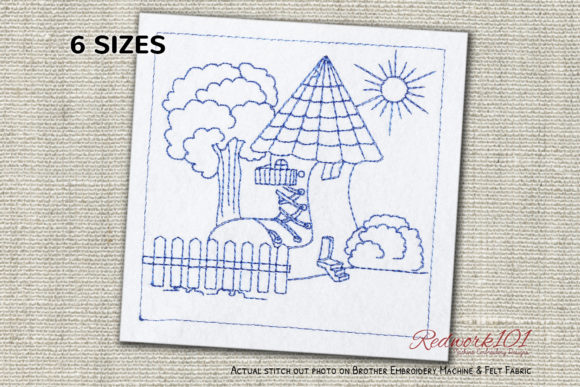
Shoe House Lineart Design
A Whimsical Silhouette That Earns Its Place on Real Projects
First impression? Clean. Quietly clever. The Shoe House Lineart Design lands like a gentle nudge from a storybook—no fuss, no clutter, just confident line work that suggests shelter, comfort, and quiet magic. It’s not busy, but it’s not empty either. As an embroidery designer who’s stitched hundreds of fairy tale motifs for baby onesies, boutique aprons, and holiday tea towels, I immediately saw where this would shine: as a subtle anchor on a linen pillow cover, a tender detail on a newborn gift set, or the quiet centerpiece of a hand-embroidered nursery wall hanging.
Where It Lives Best—And Why Customers Notice
This isn’t a design that shouts. It whispers—and that’s its strength. In real-world use, the Shoe House Lineart Design performs beautifully on medium-weight natural fabrics: cotton twill tote bags, midweight sweatshirts, unbleached muslin baby blankets, and woven kitchen towels. On a custom embroidered tote for a local children’s bookstore? Perfect—it reads clearly at 3.5 inches wide without needing fill stitches or heavy satin borders. On a soft cotton cap for a boutique baby line? Yes—but only if you hoop carefully and use tear-away + cutaway stabilizer combo to prevent puckering on the curve.
What makes it commercially smart? It feels handmade without looking amateurish. When customers see this on an Etsy listing—a linen tea towel with “Little Feet, Big Dreams” stitched below—the Shoe House Lineart Design adds narrative weight. It doesn’t distract from the text; it frames it. That kind of visual harmony builds trust. Buyers associate clean line art with intention, care, and attention to detail—exactly what handmade product shoppers are scanning for.
Where to Pause—and Stitch With Intention
Lineart looks deceptively simple until you’re stitching it on textured fabric. On terry cloth towels or looped fleece baby blankets, fine lines can disappear into the pile unless you adjust stitch length (slightly longer running stitch) and add light topping stabilizer. On stretchy knit t-shirts? Not ideal unless you’re using a high-quality cutaway and keeping the design under 4 inches wide—tight curves near the heel and roofline need stability.
The outer box mentioned in the description (“The Box Stitch shown in the picture is optional…”) is worth pausing over. If your project leans minimalist—a monochrome embroidered patch for a craft fair booth—skip it. But if you’re creating a framed nursery print or printable mockup for your Etsy shop, that optional border gives structure and helps the design stand out against busy backgrounds. Just remember: that box isn’t part of the core motif. It’s a framing tool—not a storytelling element.
Real Project Test: A Personalized Baby Gift Set
Last month, I used the Shoe House Lineart Design across three pieces: a cotton receiving blanket (hooped flat, medium tear-away), a matching burp cloth (light cutaway, dense weave), and a tiny embroidered patch sewn onto a hand-sewn muslin drawstring bag. On all three, the line held crispness—even at 2.75 inches tall. No broken segments. No thread nesting in corners. And because it’s true lineart (not filled), stitch density stayed low, reducing wear on delicate baby fabrics and keeping embroidery time efficient for small-batch production.
Customers loved the subtlety. One buyer wrote, “It felt like a secret just for us”—which tells me the design delivers emotional resonance without leaning on cliché. That’s rare in fairy tale embroidery, where dragons and castles often dominate. This one breathes.
Design Notes Every Embroiderer Should Check Before Hooping
- Test first on scrap fabric—especially if pairing with dark thread on light fabric or vice versa. Line contrast shifts dramatically depending on thread sheen and fabric nap.
- Review stitch direction. Even in lineart, stitch angle affects how smooth the curve of the roof or toe feels after stitching. Look for vector-like flow—not jagged jumps.
- Confirm hoop size compatibility. At standard scaling, this fits comfortably in a 4x4 hoop—but if you plan to resize beyond 120%, check corner integrity in your embroidery software.
- Try black-and-white mockups before finalizing listings. Lineart relies on silhouette clarity—so if it fades on a grey background preview, it’ll fade on heather grey sweatshirts too.
- Stabilizer matters more here than with dense fill designs. A flimsy tear-away won’t support clean lines on knits or loosely woven linens. Layer it.
- Licensing check is non-negotiable. Since this falls under Fairy Tales and is marketed as an embroidery file, verify whether commercial use (e.g., selling finished embroidered patches or digital embroidery files) is permitted. Don’t assume.
Why It Fits Seamlessly Into Your Creative Workflow
The Shoe House Lineart Design doesn’t ask for special treatment—it adapts. It works as a standalone machine embroidery design, a subtle applique base (trace the outline, then layer fabric inside), or even a foundation for hand embroidery (transfer and backstitch over). For Etsy sellers building cohesive collections—think “Nursery Story Set” or “Whimsy Home Bundle”—this pairs naturally with moon motifs, tiny keys, or winding stair silhouettes. It’s versatile without being vague.
Most importantly, it respects the maker’s time and the buyer’s eye. No excessive trims. No nested satin stitches begging for re-hooping. Just honest, thoughtful line work that translates cleanly from screen to stitch to shelf. In a market flooded with overdesigned digital embroidery files, that restraint is quietly revolutionary.
Final Thought: A Design That Serves the Story—Not the Other Way Around
Fairy tales endure because they hold space for wonder *and* warmth. The Shoe House Lineart Design does the same. It doesn’t try to be everything—it’s a quiet house, drawn with care, waiting to live on something real: a child’s first blanket, a barista’s custom apron, a holiday gift tagged with handwritten ink. If your craft business values authenticity over algorithm-friendly flash, this isn’t just another embroidery file. It’s a small, steady note of craftsmanship—one that earns its place, stitch by careful stitch.