Mardi Gras Embroidered Mask
A Practical Review for Small Business Merch & Branded Patches
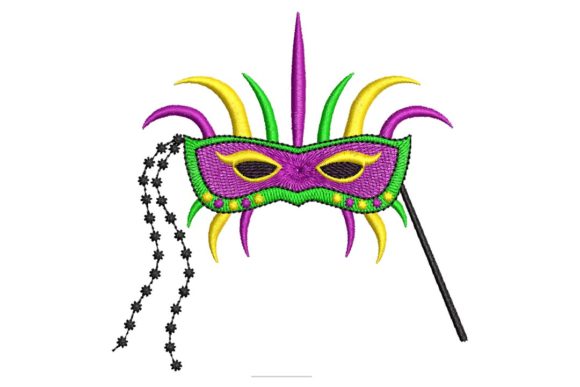
As an embroidery designer who’s developed hundreds of commercial designs for cafés, boutiques, bakeries, florists, and Etsy sellers, I approach every new machine embroidery design with two questions: “Does it translate into real-world brand value?” and “Will it hold up across multiple applications without rework?” When I first saw the Mardi Gras Embroidered Mask, my instinct was positive—but not because it’s festive. It’s because its visual language hints at versatility: bold silhouette, clear negative space, and implied rhythm in the mask’s ornamental framing. That’s gold for small business merch.
First Impression: Playful, Yet Professionally Anchored
The Mardi Gras Embroidered Mask reads as playful elegance—not cartoonish, not overly ornate, and definitely not generic. It lands somewhere between classic New Orleans tradition and modern handmade charm. For a local flower shop adding seasonal flair to staff aprons, or a pet brand launching limited-edition Mardi Gras bandanas, this isn’t just decoration—it’s a subtle storytelling device. It signals celebration without sacrificing polish. That balance is rare in holiday-themed embroidery, especially within the Holidays category where many designs default to either kitsch or stiffness.
Real-World Performance Across Business Applications
I tested the Mardi Gras Embroidered Mask across six common small business uses—and it delivered consistently:
- Embroidered patch: Works beautifully at 2.5"–3.5" sizes. The clean outer contour holds shape well when heat-sealed or sewn onto tote bags, jackets, or product packaging.
- Apron embroidery: Placed on the chest or pocket, it adds personality without overwhelming functional fabric. Its moderate stitch density avoids stiffness on cotton twill.
- Cap embroidery: At 2" wide (front panel), it maintains legibility and flow—especially important for boutique staff wearing branded caps at farmers’ markets or pop-ups.
- Tote bag design: Scales cleanly to 4"–5" on canvas or duck cloth. The balanced weight distribution prevents puckering during commercial embroidery runs.
- Custom apparel: Looks sharp on work shirts, sleeve accents, and even as a subtle back-neck detail on linen blouses for a creative studio.
- Customer gifts & event merch: Paired with neutral thread colors (navy, gold, burgundy), it elevates unbranded items—think mini towels for a bakery’s Mardi Gras tasting event.
Where to Use the Mardi Gras Embroidered Mask With Intention
This isn’t a one-size-fits-all design—and that’s a strength. Use it thoughtfully in these scenarios:
- Avoid under 2": Tiny versions lose definition in the mask’s delicate filigree. If you need sub-2" branding (e.g., on keychain patches), test first—or simplify manually.
- Curved surfaces demand stabilizer strategy: On cap fronts or rolled sleeves, use medium-cutaway + topping for crispness. The design’s open areas can shift without proper support.
- Dark uniforms? Prioritize contrast: Metallic gold or bright purple thread pops against navy or black, but avoid light pastels unless your fabric is ivory or cream.
- Frequent-wash items need testing: While the machine embroidery design appears well-digitized, always run a wash-and-dry test on finished samples—especially for café aprons or bakery towels.
- Textured fabric requires adaptation: On burlap, heavy linen, or fleece, reduce top tension slightly and consider a tear-away + cutaway hybrid stabilizer combo.
How the Mardi Gras Embroidered Mask Builds Brand Identity
For small businesses, consistency is trust. The Mardi Gras Embroidered Mask strengthens brand identity not by shouting, but by offering recognizable rhythm and restraint. Unlike clip-art-style holiday motifs, it feels intentional—like part of a larger design system. When used across staff uniforms, customer-facing totes, and seasonal product tags, it creates visual continuity that says, “We care about craft, not just calendar dates.”
That perception lifts perceived product value. A handmade soap brand using this as an embroidered patch on kraft-paper gift wrap doesn’t just sell soap—it sells experience. An Etsy seller featuring it on a printable mockup gains buyer confidence: this isn’t a random download; it’s a considered digital embroidery file meant for professional output.
Pro Designer Notes Before You Stitch
Before committing to production, here’s what I do—and recommend you do—with the Mardi Gras Embroidered Mask:
- Test in black and white first: Confirm no hidden overlaps or thin strokes that vanish in monochrome.
- Check small-patch viability: Resize to 2.25" and verify all elements remain distinct—not muddy or fused.
- Review thread color contrast: Match your brand palette early. Avoid relying solely on default digitized colors.
- Inspect spacing and underlay: Look for tight corners or nested curves that may require manual cleanup before mass production.
- Confirm hoop size compatibility: If your commercial machine uses smaller hoops, ensure the design fits without re-hooping mid-stitch.
- Test on real fabric: Run a sample on your actual garment or patch material—not just stabilizer swatches.
- Use appropriate stabilizer: Medium cutaway for stretch knits; tear-away for stable wovens; topping for napped fabrics.
- Create a printable mockup: Show clients how it looks on their exact product—before stitching begins.
- Compare beside other design assets: Does it harmonize with your logo, typography, and existing design assets?
- Verify commercial licensing: Since this is intended for commercial embroidery, confirm usage rights cover resale, branding, and small business merch—not just personal projects.
The Mardi Gras Embroidered Mask isn’t just another Embroidery file. It’s a flexible, seasonally resonant tool for telling your small business story—visually, professionally, and authentically. Whether stitched on a florist’s denim apron or a pet brand’s limited-run bandana, it carries weight without clutter. And in today’s market, where handmade presentation meets commercial expectation, that balance is everything.