Indian Peacock Redwork: Bold, Timeless & Booth-Ready
As an embroidery designer who’s prepped over 200 craft fair booths—from Portland bazaars to Nashville maker markets—I’ve learned that not every bird design earns a second glance. But Indian Peacock Redwork does. It lands with presence: elegant yet grounded, intricate but legible, traditional without feeling dated. It reads as premium handmade at first glance—not “cute,” not “rustic,” not “minimal.” It’s decorative with intention, and that makes all the difference when your booth has 37 other vendors selling embroidered tea towels.
Where Indian Peacock Redwork Shines on Craft Fair Products
Let’s talk real-world placement. On a heavyweight cotton tote bag? Absolutely—centered above the seam or scaled slightly larger for impact. The peacock’s fanned tail naturally draws the eye upward, making it ideal for vertical product displays. As an apron embroidery, it works beautifully on the bib panel: large enough to read from six feet away, detailed enough to invite closer inspection. For tea towel embroidery, place it in the lower corner or centered near the top hem—its clean lines hold up against kitchen wear and frequent washing.
On caps? Proceed with caution. The design’s width and tail spread demand careful placement and a flexible hoop size—test it on scrap denim first. As an embroidered patch, though? A standout. Its redwork style (clean red-on-white or red-on-cream contrast) reads instantly, even pinned to a denim jacket at a crowded market aisle. Small fabric pouches and pillow covers benefit most from its balanced composition—it fills space without overwhelming, and the symmetry feels intentional, not repetitive.
What Makes This Design Sell—And What Requires Care
Indian Peacock Redwork succeeds because it’s glanceable, giftable, and genre-fluid. It appeals across age groups and aesthetics: boho buyers see artistry; farmhouse shoppers see heritage; modern boutiques see refined detail. That versatility is gold for Etsy sellers juggling multiple listings—this one design can anchor a spring collection and reappear in holiday gifting bundles.
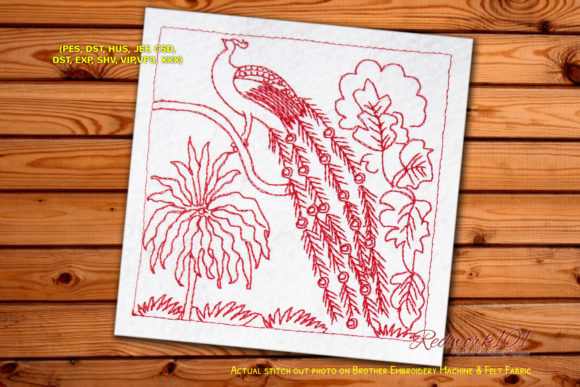
But let’s be honest: redwork isn’t forgiving. Tiny feather tips, tight curves in the neck, and layered tail plumes mean stitch density matters. On textured towels or thick canvas, those fine details can blur. Dark fabrics require high-contrast thread—don’t assume standard red will pop on navy or charcoal. And if you’re scaling down for a 2-inch embroidered patch? Trim the outer box (remember: The Box Stitch shown in the picture is optional). That outer frame isn’t part of the core motif—it’s a layout aid, not a design element.
Photography, Mockups & Online Conversion
This design photographs exceptionally well. Its strong silhouette and limited color palette (red + neutral ground) create crisp, scroll-stopping Etsy thumbnails. Pair it with natural light and a linen backdrop, and your printable mockup will outperform competitors using busier motifs. For digital sellers, include at least three context shots: one flat-lay (tote + tea towel + pouch), one in-hand (someone holding an embroidered apron), and one detail close-up showing stitch clarity. Buyers need to believe it’s handmade—not digitized filler.
That said, avoid overloading your listing with tiny variations. One clean digital embroidery file, clearly labeled with recommended hoop size and stabilizer notes, builds more trust than five mismatched versions. If the original file includes optional box stitching, call it out plainly: “Box outline is decorative only—omit for dark fabrics or small-scale applications.”
Production Notes Every Embroidery Designer Should Check
Before cutting into your best organic cotton:
- Test on scrap fabric—especially if using textured weaves or terry cloth.
- Confirm thread contrast: Standard red may dull on cream or oatmeal; try burgundy or brick for richer depth.
- Review spacing: Does the tail clear the seam allowance on your tote bag pattern? Measure before hooping.
- Verify hoop size compatibility: Some versions of Indian Peacock Redwork stretch wide—don’t assume it fits a 4x4 hoop without checking.
- Inspect stitch density in feather areas—overly dense sections can pucker thin fabrics or trap lint on tea towels.
- Use the right stabilizer: Tear-away for stable wovens, cut-away for knits or stretchy pouch linings.
- Create at least one real mockup—not just a digital preview. See how it drapes, how light catches the stitches, how it feels in hand.
- Compare fabric colors side-by-side: A pale peach linen may mute red tones; a warm ivory enhances them.
- Confirm commercial licensing: If selling finished products (not just the embroidery file), ensure your license permits physical resale—many “for personal use only” files prohibit this.
Why Indian Peacock Redwork Strengthens Your Brand & Booth
In a sea of florals and quotes, Indian Peacock Redwork signals craftsmanship. It tells customers: You value tradition, precision, and visual storytelling. That perception lifts perceived value—shoppers pay more for pieces that feel curated, not mass-produced. On your craft fair table, it anchors a cohesive story: think indigo-dyed totes + redwork peacocks + hand-stitched tags. No need for signage shouting “handmade”—the design itself whispers it.
It also supports repeat engagement. Customers remember distinctive motifs. They’ll return next season looking for your “peacock line”—maybe on a new pillow cover or market bag. That loyalty compounds faster than chasing trends. And for boutique makers building a signature aesthetic? This is a cornerstone design asset, not a one-off.
Final Thought: It’s Not Just a Bird—It’s a Statement
Indian Peacock Redwork isn’t merely another machine embroidery design in your folder. It’s a conversation starter, a quality signal, and a reliable seller across categories—from small shop product to wholesale-ready commercial embroidery. Yes, it asks for thoughtful execution. But the payoff—higher average order value, stronger booth recall, and deeper buyer connection—is worth every test stitch.
So go ahead: hoop it, stitch it, photograph it, and hang it front-and-center. When someone pauses at your table, leans in, and says, “Oh—what *is* that?” you’ll already know the answer.